The money, explained
How a betting shop earns on virtual racing
A virtual racing shop earns the difference between what customers stake and what winning tickets pay out. This page walks through how that works, with example figures, so you can judge the business before you register.
- races never stop
- 24/7
- games on the platform
- 14
- machines to install
- 0
The life of a ticket
A customer picks a runner and pays the cashier. The till prints a ticket. The race runs, the result settles, and the ticket is now worth something or nothing. A winning ticket is paid when the customer brings it back. Some winning tickets are never brought back, and the platform tracks those as unclaimed until they are paid or expire.
Every one of those steps is recorded against the shop, the cashier and the till. The back office shows staked, paid and outstanding for any day you pick.
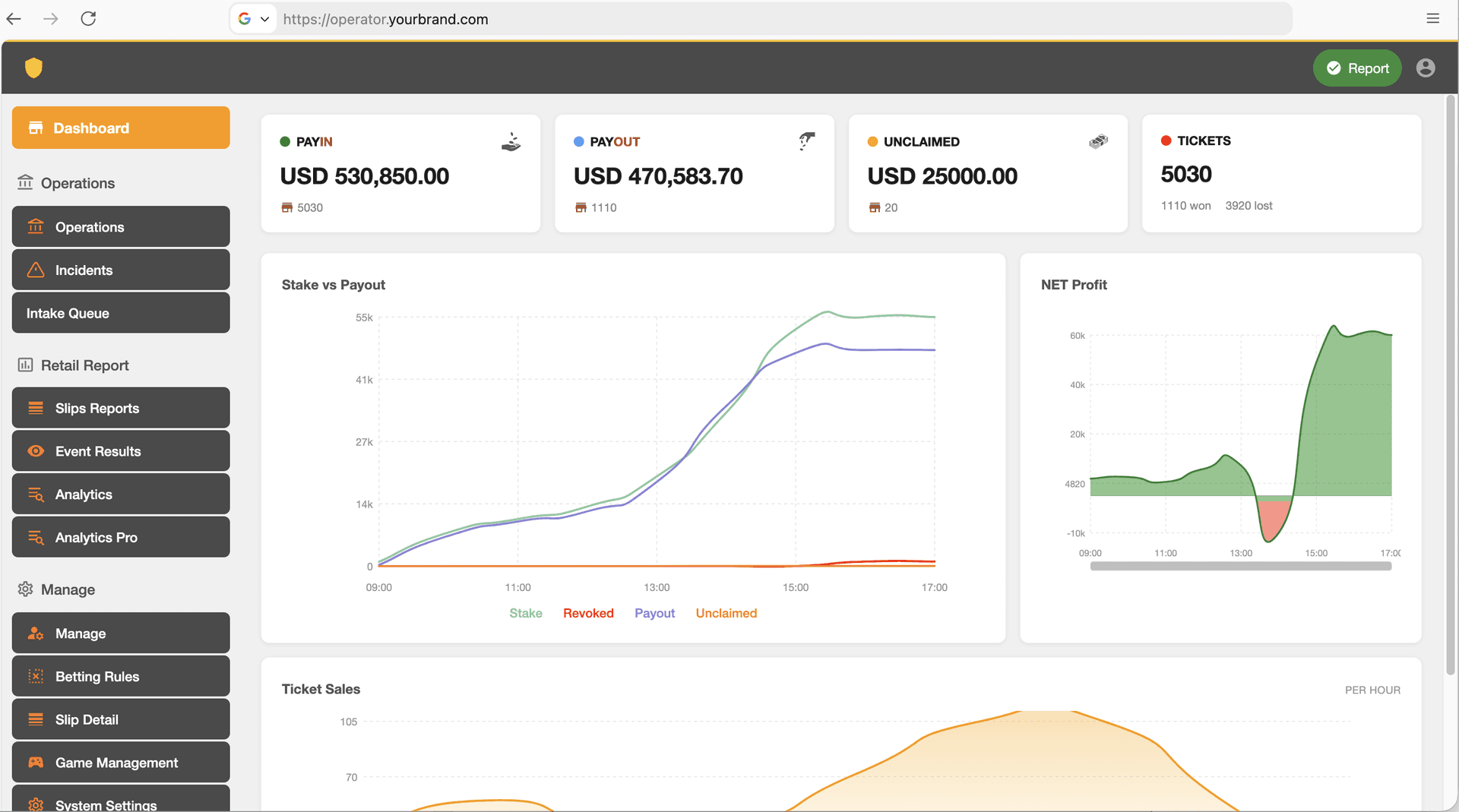
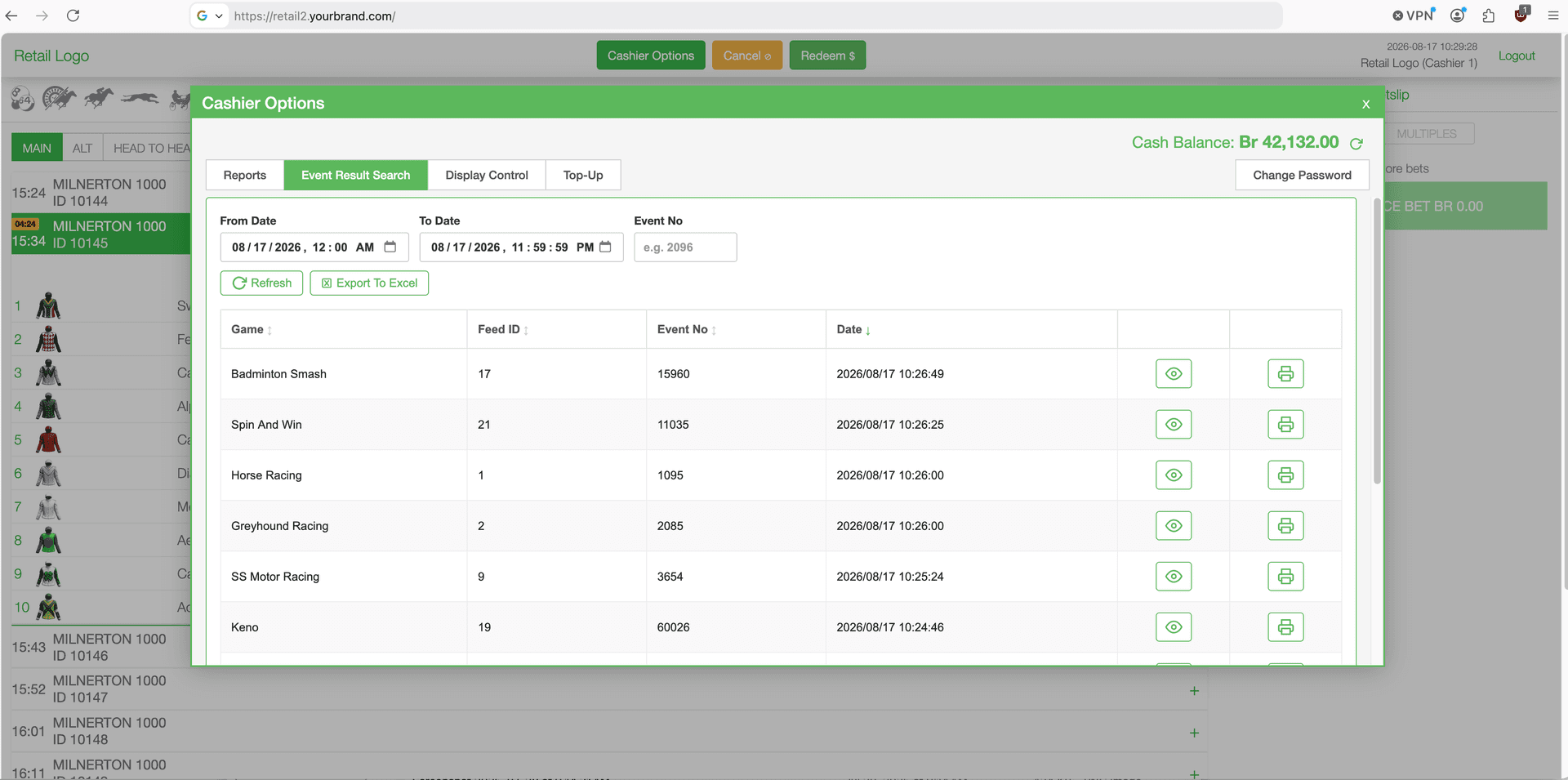
The back office: pay-in, payout and unclaimed for the day, and every settled event.
What hold means
Hold is the share of total stakes the shop keeps after paying winners. If customers stake 530,850 in a period and winning tickets pay 470,584, the shop held 60,266. That is 11.4 percent of everything staked. Those are example figures, and the arithmetic is the point: hold is a result you read off your own ledger, not a promise anyone can make you.
Hold moves day to day. Favourites win some days and outsiders win others. Over enough races it settles toward the game design, which is why turnover matters as much as any single day.
Continuous racing drives turnover
Generated racing runs back to back all day, every day. Nothing is called off and there is no fixture list to run out, so the shop is never waiting for something to bet on. Real racing cannot say that, and a card of real fixtures can be rained off.
More settled races means more tickets through the same till with the same staff. That is the whole argument.
 LIVE
LIVEThe feed as a shop screen shows it. The next race is always close.
What the platform takes
Commercial terms are agreed when a shop signs up. They depend on several things: the market, the size of the estate and how the shop wants to settle. We do not publish one number because there is not one number.
What we can say plainly: registering costs nothing, the demo costs nothing, and there is no hardware to buy. You see the product and your own likely numbers before any commercial conversation starts.
Frequently asked questions
- Is a virtual racing shop profitable?
- The model is the same as any bookmaking: the shop keeps the difference between stakes and payouts, and hold settles toward the game design over enough races. Whether a given shop is profitable depends on footfall and stakes. The demo and a second-terminal trial exist so you can measure with your own customers instead of trusting a page.
- What percentage does the shop keep?
- Hold is read off the ledger, not set by a dial. In the worked example on this page it is 11.4 percent of stakes over the period shown. Your figure depends on which games run, what your customers play and the period you measure.
- What about tickets nobody collects?
- A winning ticket that is never brought back stays on the books as unclaimed. The back office shows the outstanding amount at all times, so the shop always knows what it may still have to pay.
- What does SportLogic charge?
- Terms are agreed per operator because they depend on several factors. Registration and the demo are free, so the commercial conversation happens after you have seen the product, not before.
More for shop operators
- Virtual sports for betting shopsWhat a shop gets, what it needs on the counter, and what it costs to start.
- Virtual sports as a second terminalFor a shop that already runs virtual games and does not want to switch anything off.
- Virtual sports with no hardware in the shopRaces arrive as video, so there is no machine to buy, install or replace.
- White-label virtual sports platformYour brand and your domain on the same platform and the same games.
- Virtual sports agent networkFor agents and sub-distributors signing shops in their own area.
- How virtual racing results and odds workPrices fixed before the race, a random result per race, one settlement for everyone.
- What virtual sports software costsRevenue share, fixed fees and hardware rental explained, and what costs nothing here.
See the numbers games running
Register and open a demo link that works for 7 days. No hardware, nothing to pay.